 Lab or natural?
 Find a ring size
 Buying on 47th Street
Guide / Diamonds
Loose diamond or finished ring: which costs less?
Often the loose stone costs less, but the saving is smaller than people expect, and part of the risk moves to you. Buying loose lets you compare many graded stones and pay only for the setting you want; buying the stone through the jeweler who sets it puts the stone, the fit and any problem with one person.
- Where the saving comes from
- What it can cost you
- Side by side
- What gets checked on your stone
- When each one makes sense
Most people asking this have found a stone online and want to know whether to buy it and take it to a jeweler for setting a stone you bought. That works, and jewelers on 47th Street set customers' own stones every week. Before you pay, it helps to know what you gain, what you take on, and what the jeweler will look at when you bring it in.
Where the saving comes from
A finished ring in a store window is priced as one object: a stone, a mounting, the labor to put them together, and the store's margin on all of it. When you buy the stone on its own, you can compare hundreds of graded stones side by side, by report, and pick the one that gives you the most for your budget. You then pay a jeweler for the setting and the labor, and nothing else.
The saving is real when the stone is most of the price, which is usually the case with a larger center diamond. It is small, or gone, when the ring is mostly metal and small stones, such as a pavé band or a halo, because the labor and the small diamonds cost the same either way.
There is also a 47th Street version of this. Many custom jewelers here do not keep every stone in a safe. They borrow stones from dealers in the same building, on what the trade calls memo, so they can show you several in an afternoon. You still see graded stones side by side, and the jeweler who sets the stone is the one who chose it.
What it can cost you
The return window. Stones bought online often come with a return window of a few weeks. A custom ring can take longer than that once the drawing, the casting and the setting are done. If the setting reveals a problem after the window has closed, the stone is yours to keep.
The fit. A setting is made to a stone's millimeters, not its carat weight. A stone cut deep sits higher and needs a taller head; a shallow one can look bigger from above but leaks light. Some stones simply do not suit the design you had in mind, and you only find out once the jeweler measures them.
The risk while it is set. Diamonds are hard, but they can chip at a thin edge, at the points of a pear or marquise, or where a small crack reaches the surface. When the jeweler supplied the stone, that risk is usually theirs. When you supply it, ask before you hand it over who carries it, and get the answer in writing.
Two sellers, two answers. If a prong fails or a stone turns out to be different from its report, you deal with two businesses instead of one. Each can point at the other.
Side by side
| Question | You buy the stone loose | The jeweler supplies the stone |
|---|---|---|
| Choice of stones | Very wide, from many sellers | What the jeweler can source and show you |
| Seeing it first | Often photos and video only | In hand, next to other stones |
| Fits the design | Checked after you have paid | Chosen to fit the drawing |
| Risk during setting | Ask; it may be yours | Usually the jeweler's |
| Returns | The stone seller's window | One set of terms for the whole ring |
| Who to call later | Two businesses | One |
Neither column is wrong. The one that suits you depends on how much you trust your own eye on a stone and how much the saving is worth to you. If the stone is a diamond, the report also tells you whether it is natural or laboratory-grown, which changes the price far more than where you buy it. For how to read that report, and how to check a seller on the street, see how to check a Diamond District jeweler.
What a jeweler checks on a stone you bring
This is what a careful setter does when you hand over a loose stone. Ask to watch; none of it takes long.
- Weight. The stone goes on a carat scale. The reading should match the report.
- Measurements. Length, width and depth with a gauge, in millimeters. These, not the carat weight, are what the setting is made to.
- The inscription. If the report says the girdle is laser-inscribed, the number is found under the microscope and read against the report.
- The edge. The girdle is checked all the way round. A very thin girdle, or a chip already there, is where a prong can do damage, so it is pointed out to you before work starts.
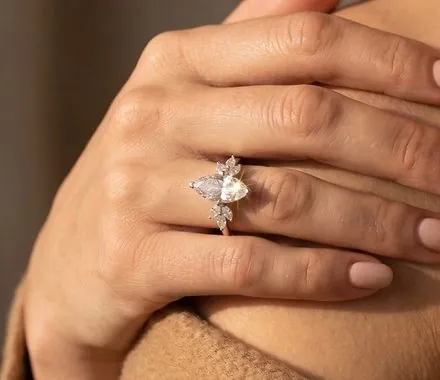
- Points and corners. Pears, marquises, princesses and hearts have points that need a V-prong or a bezel to protect them.
- Treatments. A fracture-filled diamond holds a filler that heat can cloud, so the setter needs to know before any torch work.
Then the stone is papered: folded into a stone paper with its weight, measurements and report number on the outside, and written on your receipt. Ask to see that written down before you leave it.
When each one makes sense
Buy the stone loose if you know exactly what you want, you are comfortable reading a grading report, the center stone is most of your budget, and the seller's return window is long enough for the ring to be made.
Let the jeweler supply it if you want to see stones in person before choosing, your design depends on an exact stone size, or you would rather have one person answer for the whole ring. For an engagement ring especially, many people find that easier. You can see the settings and shapes on custom engagement rings made here.
Either way, ask for a quote on the setting before you buy the stone. Knowing the full cost of both routes is the only honest way to compare them. What Ben works with: Both natural and laboratory-grown, whichever you prefer.
Have a stone, or still choosing?
Send Ben a photo of the stone and its report, or ask what he would suggest for your budget. How your own stone is handled.